

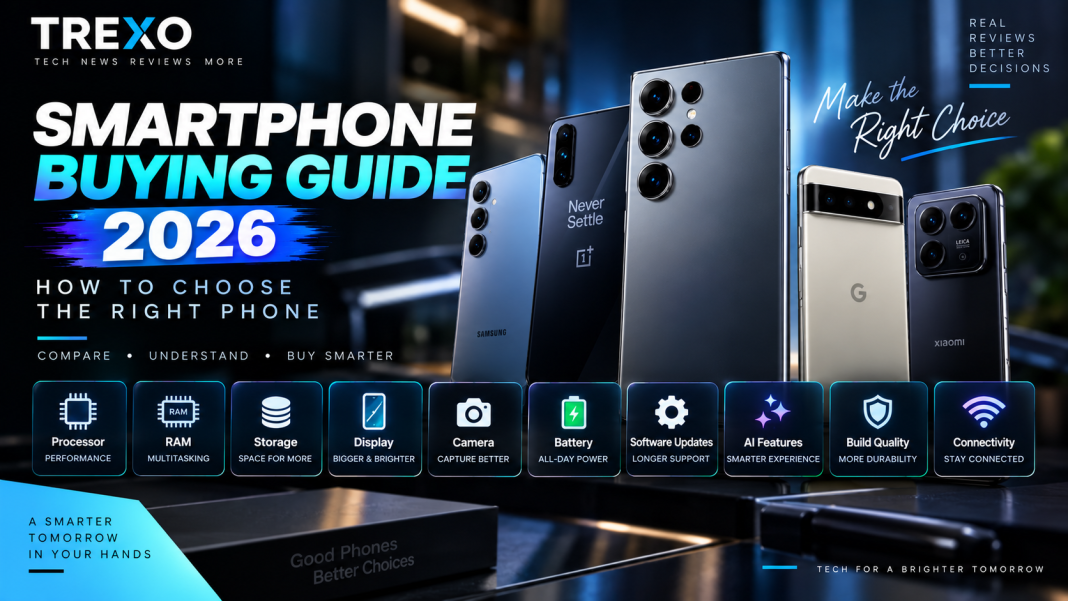

Buying a smartphone in 2026 can be surprisingly difficult. Two phones at similar prices may offer completely different processors, cameras, displays, software policies and AI features.
The best smartphone isn’t necessarily the one with the longest specification sheet. The right choice depends on how you actually use your phone.
This smartphone buying guide 2026 explains the most important things to check before spending your money.
- Start With Your Budget
Decide your maximum budget before comparing smartphones.
It is easy to start looking at a ₹25,000 phone and gradually convince yourself to spend ₹40,000 because each upgrade appears small individually.
Instead, establish a realistic range and compare the strongest options available within it.
Also consider the complete cost. A phone may not include a charger, case or other accessories you need.
- Choose the Right Processor
The processor affects everyday responsiveness, gaming, camera processing and how well a smartphone handles demanding applications.
But don’t choose a phone simply because one processor has a higher model number.
For basic calling, messaging, social media and video streaming, a good mid-range processor can be sufficient.
Users who regularly play demanding games, edit video or expect to keep their phone for several years may benefit more from higher-end hardware.
Independent performance and thermal testing can be more useful than marketing claims alone.
- How Much RAM Do You Need?
RAM helps your smartphone keep applications available while multitasking.
For many users in 2026, 8GB RAM is a sensible target when buying a mainstream Android smartphone.
Heavy multitaskers and premium-phone buyers may consider 12GB or more, but additional RAM alone does not guarantee better performance.
Software optimisation and the processor matter too.
- Don’t Ignore Storage
Storage requirements have increased as cameras produce larger photographs and videos and applications become bigger.
128GB may be adequate for lighter users, while 256GB offers more breathing room for people who keep many photos, videos, games and offline downloads.
Before buying, check whether the phone supports expandable storage if that feature matters to you.
Also remember that advertised storage isn’t entirely available to the user because the operating system and preinstalled software occupy some of it.
- Display Quality Matters
Your smartphone display is something you interact with constantly.
Important factors include:
OLED/AMOLED versus LCD
Resolution
Brightness
Refresh rate
Outdoor visibility
Display size
A 120Hz display can make scrolling and animations appear smoother, but refresh rate isn’t the only measure of display quality.
Brightness, colour reproduction and power efficiency are also important.
- Don’t Judge Cameras by Megapixels Alone
A 200MP camera isn’t automatically better than a well-implemented 50MP camera.
Camera quality depends on several factors, including sensor size, lens quality, image processing, stabilisation and software.
Consider what you actually photograph.
If you frequently take portraits or distant photographs, a good telephoto camera may matter. Travellers may value an ultra-wide camera, while video creators should pay attention to stabilisation and video capabilities.
Look at real camera samples rather than comparing megapixel numbers alone.
- Battery Capacity and Charging
Battery capacity is commonly measured in mAh, but a larger number doesn’t automatically guarantee longer battery life.
Processor efficiency, display technology, network usage and software optimisation all affect endurance.
Around 5,000mAh has become common across many Android phones, but independent battery testing is still useful when comparing devices.
Also check charging speed and whether the required fast charger is included in the box.
Wireless charging can be convenient, but it may not be necessary for everyone.
- Software Updates Are Important
Software support should be part of your buying decision, especially if you plan to keep your smartphone for several years.
Look at the manufacturer’s stated policy for:
Android/OS upgrades and security updates.
Longer support can help a device remain secure and compatible with newer applications for longer.
Premium phones from some manufacturers now advertise long update commitments, but policies vary by device and region.
- Consider AI Features Carefully
AI has become one of the biggest smartphone marketing themes.
Modern phones can offer AI-powered photo editing, translation, transcription, writing assistance and contextual search.
Some of these features are genuinely useful, while others may have little impact on your daily experience.
Read our Best AI Features You Can Use on Your Smartphone in 2026 guide to understand which smartphone AI tools can actually be useful.
Internal link: Link that article title to your TREXO AI article.
- Check Build Quality and Protection
If you expect to use a phone for several years, durability matters.
Check features such as:
Water and dust resistance
Display protection
Frame/material quality
Repair options
Availability of cases and screen protectors
An official IP rating can provide useful information about tested resistance, but it should not be interpreted as permission to deliberately expose a phone to water.
- Connectivity and Everyday Features
Don’t overlook smaller features that may matter every day.
Depending on your requirements, check for:
5G support, Wi-Fi capabilities, Bluetooth, NFC, eSIM, dual SIM, stereo speakers, fingerprint sensor and USB connectivity.
Feature availability varies between models and markets.
- Think About Long-Term Performance
A phone that feels fast on the first day may eventually have to handle larger apps and newer software.
If you intend to keep your device for four or five years, consider buying enough storage and performance headroom rather than choosing only for today’s requirements.
If you already have an Android phone that feels slow, try our How to Make Your Android Phone Faster: 10 Simple Tips That Actually Help guide before replacing it.
Internal link: Link the article title to your existing Android Faster post.
Which Smartphone Should You Buy?
There is no single smartphone that is right for everyone.
A photography-focused buyer may prioritise cameras. A gamer may care more about sustained processor performance and cooling. A business user may value battery life, security and software support.
Before purchasing, compare at least two or three phones in your budget based on the features you will actually use.
Don’t pay extra simply because a specification looks impressive on paper.
Final Thoughts
A good smartphone purchase starts with understanding your own requirements.
Set your budget first, then compare performance, RAM, storage, display, cameras, battery, software support and durability.
AI features can be a useful bonus, but they shouldn’t distract you from fundamentals such as battery life and long-term software support.
The goal isn’t to buy the smartphone with the most features. It’s to buy the smartphone whose features best match how you use it.